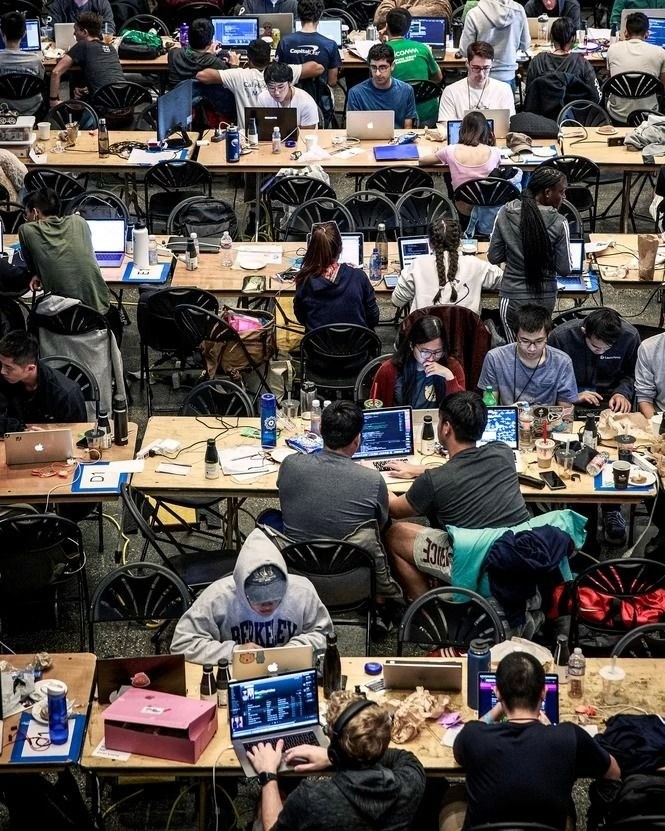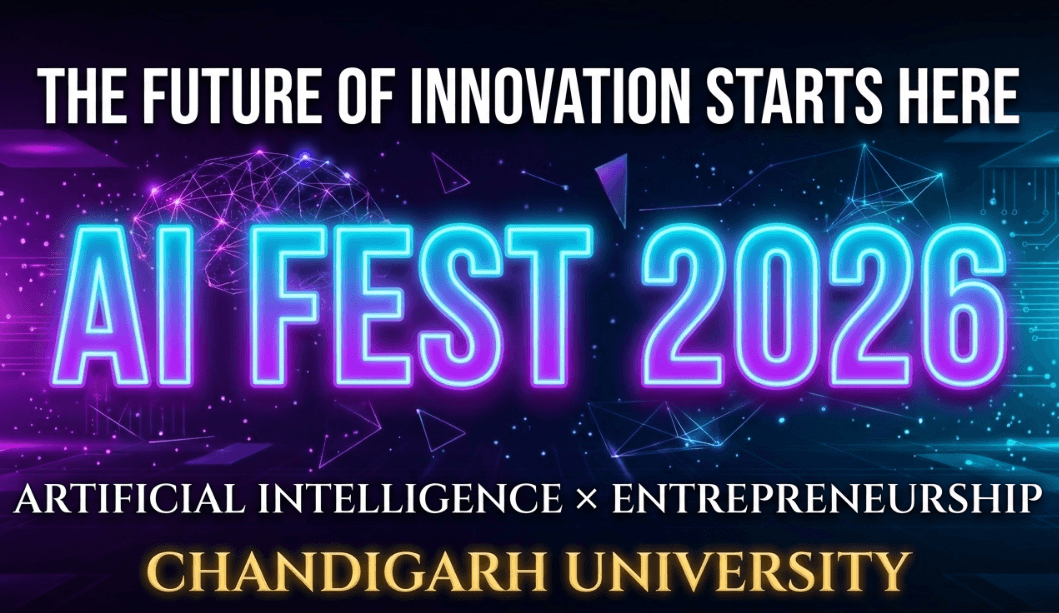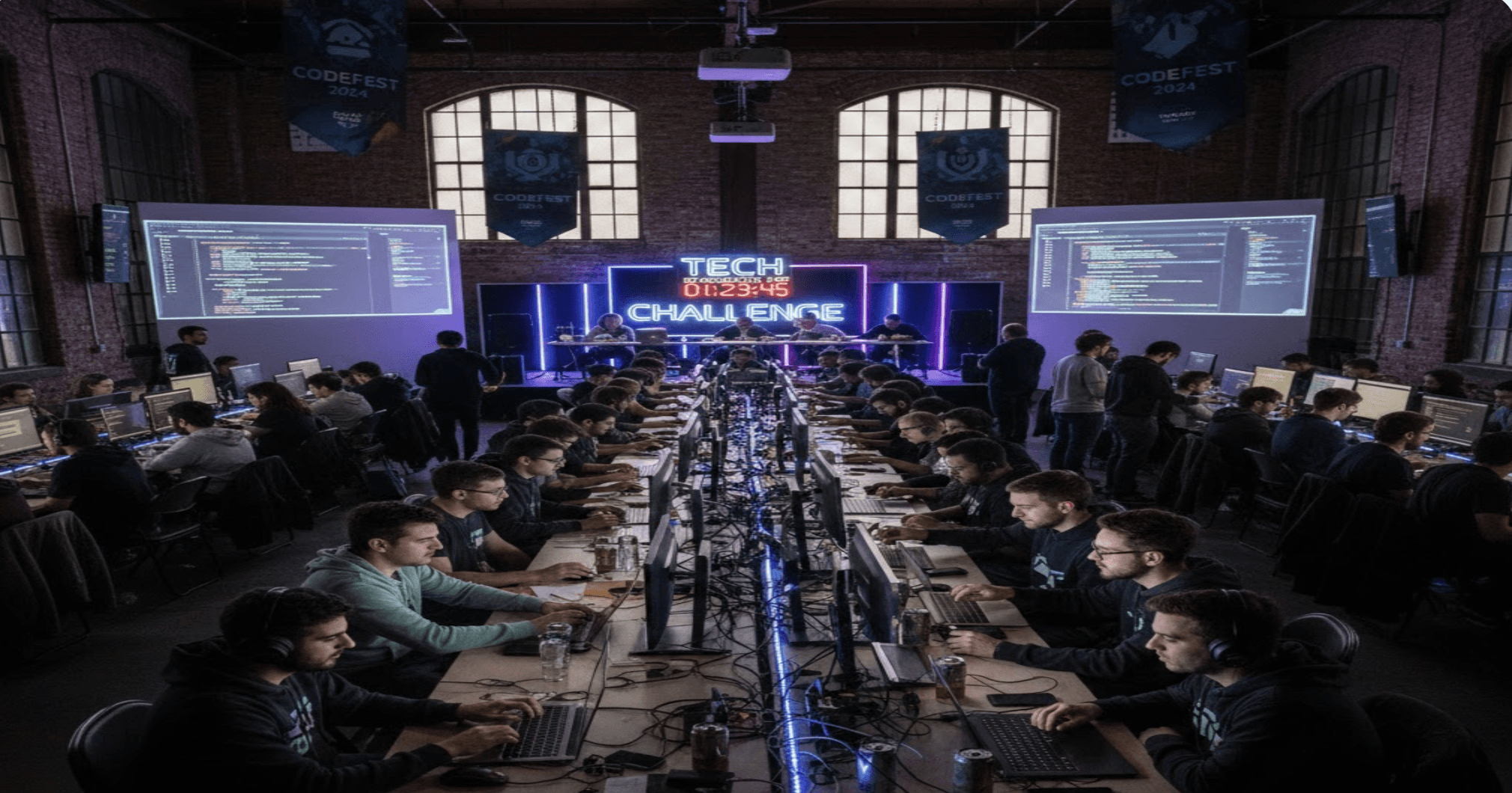
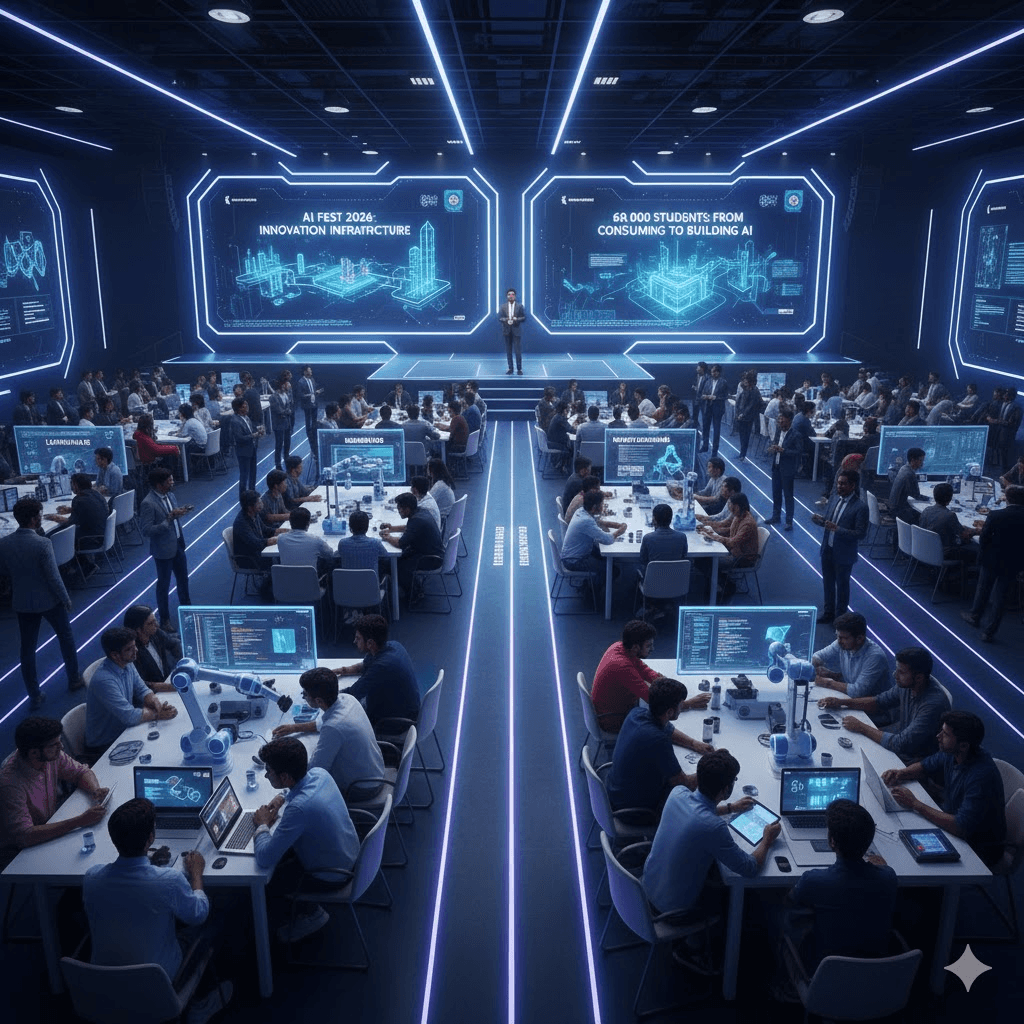
In three weeks, over 60,000 students will gather at Chandigarh University for AI Fest 2026, India’s first large-scale national AI gathering. The numbers are striking 400+ startups, $6 million in funding, 50+ events but numbers alone don’t capture what’s actually happening at events like these. They tell us scale, not significance.
I’ve been thinking about what makes these festivals matter, particularly now, when AI is simultaneously everywhere and nowhere in Indian student life. Everyone talks about it. Few understand how to build with it. Events like AI Fest 2026 are trying to bridge that gap, and the way they’re doing it reveals something important about how innovation actually happens in practice.
The Problem with Isolated Learning
Most students encounter AI through one of two extremes: theoretical lectures that feel disconnected from reality, or tutorial videos that promise to make you an AI engineer in 30 days. Neither approach works particularly well.
Theory without application becomes abstract. You can understand transformer architectures on paper but have no intuition for when to use them or what real constraints look like. Application without foundation becomes cargo-culting copying code patterns without understanding why they work or when they break.
Student innovation festivals create a third space. They’re not classrooms and they’re not workplaces, but they borrow from both. The structure is educational, but the problems are real. The stakes are lower than industry, but higher than homework. You can fail, and failure is expected, but there’s also real funding and real mentorship on the table.
This middle ground matters because innovation requires both knowledge and practice, but also something harder to define: the confidence to try something that might not work. Festivals normalize experimentation in a way that traditional education often doesn’t.
What AI Fest 2026 Is Actually Doing
Looking at the three-day structure of AI Fest reveals a thoughtful progression that mirrors how innovation actually happens.
Day 1 is InnovFest—34+ discipline-specific competitions alongside panel discussions with industry leaders, academics, and founders. This is about breadth. Students see AI applications across healthcare, agriculture, finance, infrastructure, and other sectors. The implicit message: AI isn’t one thing. It’s a set of tools that look different in different contexts.
Day 2, called SANDBOX, shifts to depth. The name is deliberate a sandbox is where you build without predetermined outcomes. This day includes founder-investor interactions, creator roundtables, mentorship sessions, and a “Pitching Battlefield.” Two cohorts launch: one focused on medical applications, another on media. The structure creates what I’d call productive collision people working on different problems in proximity, with formal sessions creating opportunities for informal learning.
Day 3 is Campus Tank Grand Finale a nod to reality TV that’s actually doing something serious. Startup exhibitions, demo days, investor panels. This is where conceptual work meets market reality. You don’t just build something; you have to explain why it matters and why someone should fund it.
What makes this structure work is the sequence. You start with breadth (what’s possible), move to depth (what you can build), then end with reality testing (what the market needs). Most events do one of these well. Doing all three requires real planning.
The Four Narratives That Frame It All
AI Fest organizes its content around four themes, and they’re worth examining because they reveal assumptions about what students need to understand.
“Evolving AI with Evolving Humans” addresses the replacement anxiety that dominates popular discourse. The framing AI as augmentation rather than replacement—isn’t new, but placing it first signals a deliberate choice: before we talk about technology, we talk about people. This matters pedagogically. Students who see themselves as potential victims of automation learn differently than those who see themselves as potential builders.
“Ethics, Trust & Governance” is the hard stuff regulation, data responsibility, societal impact. This isn’t typically what students at a tech festival want to hear about, which is precisely why it needs to be there. Real AI work involves messy questions about privacy, bias, and power. Addressing these early, with policymakers and legal experts present, signals that these aren’t afterthoughts.
“AI-Engineered Reality” focuses on deployment how AI moves from prototype to production across healthcare, finance, smart cities, and consumer experiences. This is the execution layer, where theoretical understanding meets operational complexity.
“Technical Frontiers” dives into the backend: agents, platforms, open-source systems, no-code tools. This is the “how it’s built” track, demystifying modern AI architecture for students who want to understand the machinery.
The progression from human-centered framing to technical implementation is intentional. You could run this sequence in reverse start with how AI works, end with human implications but that would produce different learning. Beginning with people keeps the human dimension visible throughout.
Why This Matters Beyond the Event
Here’s what I find personally compelling: these festivals are creating infrastructure that doesn’t otherwise exist for most students.
Consider the Campus Tank initiative, which has a $6 million fund. That’s real capital available to student founders. Or initiatives like “Zero to One,” which has helped launch 40+ MVPs, or “HackWithUttarPradesh,” which has launched 80+. These aren’t hypothetical opportunities they’re operational programs with track records.
For students outside major metros or elite institutions, access to capital, mentorship, and industry networks is limited. Events like AI Fest create temporary but intense access. You get three days to pitch investors who wouldn’t otherwise see your work, learn from founders you couldn’t otherwise meet, and connect with peers working on similar problems.
The temporariness is both limitation and feature. Three days isn’t enough to build deep expertise, but it’s enough to shift trajectory to meet a co-founder, get introduced to a mentor, see a problem from a different angle, or realize you’re working on something that actually has market demand.
The Uncomfortable Realities
But let’s be honest about limitations, because festivals like this can’t solve structural problems.
Access remains uneven. While the event aims for inclusivity, simply getting to Chandigarh for three days requires resources many students don’t have. Online components help, but the most valuable interactions happen in person. Geographic and economic inequality shapes who can participate.
Hype versus substance is a real tension. With 60,000 attendees and $6 million in funding, there’s natural pressure to oversell. The risk is that students leave with inflated expectations about how quickly they can build successful AI companies or how easy it is to secure funding. The reality that most startups fail, that building good AI products is genuinely hard, that success requires sustained effort well beyond a three-day festival can get lost in the excitement.
Quality control is difficult at scale. With 50+ events and hundreds of startups, maintaining consistently high standards is challenging. Not every pitch will be viable. Not every mentor session will be valuable. Not every competition will be well-designed. Scale creates opportunities but also dilutes quality.
The follow-through question. The hardest part of any festival is what happens after. Students return to campus energized but face immediate practical obstacles: academic obligations, limited local resources, team members with divergent priorities. The festival creates momentum, but sustaining it requires infrastructure that doesn’t exist for most participants.
What Success Actually Looks Like
I think about success here in two timeframes.
Short-term: Students leave with clearer understanding of AI’s practical applications, realistic sense of what building requires, and concrete next steps whether that’s joining a cohort, applying to an accelerator, or connecting with potential co-founders.
Long-term: A percentage of participants go on to build meaningful projects. Not all will be startups; some will be research papers, open-source tools, or applications within existing organizations. The measure isn’t how many unicorns emerge, but how many people develop the capability and confidence to work on hard technical problems.
The real value might be even simpler: normalizing the idea that students can be builders, not just consumers, of AI technology. That Indian students can create tools that serve Indian contexts, rather than only importing solutions designed elsewhere.
Looking Forward
AI Fest 2026 is one event, but it’s part of a broader shift in how India approaches technical education and innovation. The emphasis on student-led building, the involvement of policymakers alongside technologists, the focus on sector-specific applications rather than generic AI these signal a maturing ecosystem.
The challenges remain significant. Bridging the gap between what festivals can do and what sustained innovation requires. Ensuring access is truly broad rather than limited to already-privileged students. Maintaining substance as scale increases. Creating pathways from student projects to sustainable ventures.
But events like this matter because they make the abstract concrete. AI stops being something that happens in Silicon Valley or research labs and becomes something you can actually build, in the company of peers, with support from people who’ve done it before.
For 60,000 students gathering in Chandigarh later this month, those three days won’t solve every problem. But they might provide something equally valuable: proof that building is possible, and a community of people attempting it together.
That’s not everything, but it’s not nothing either.