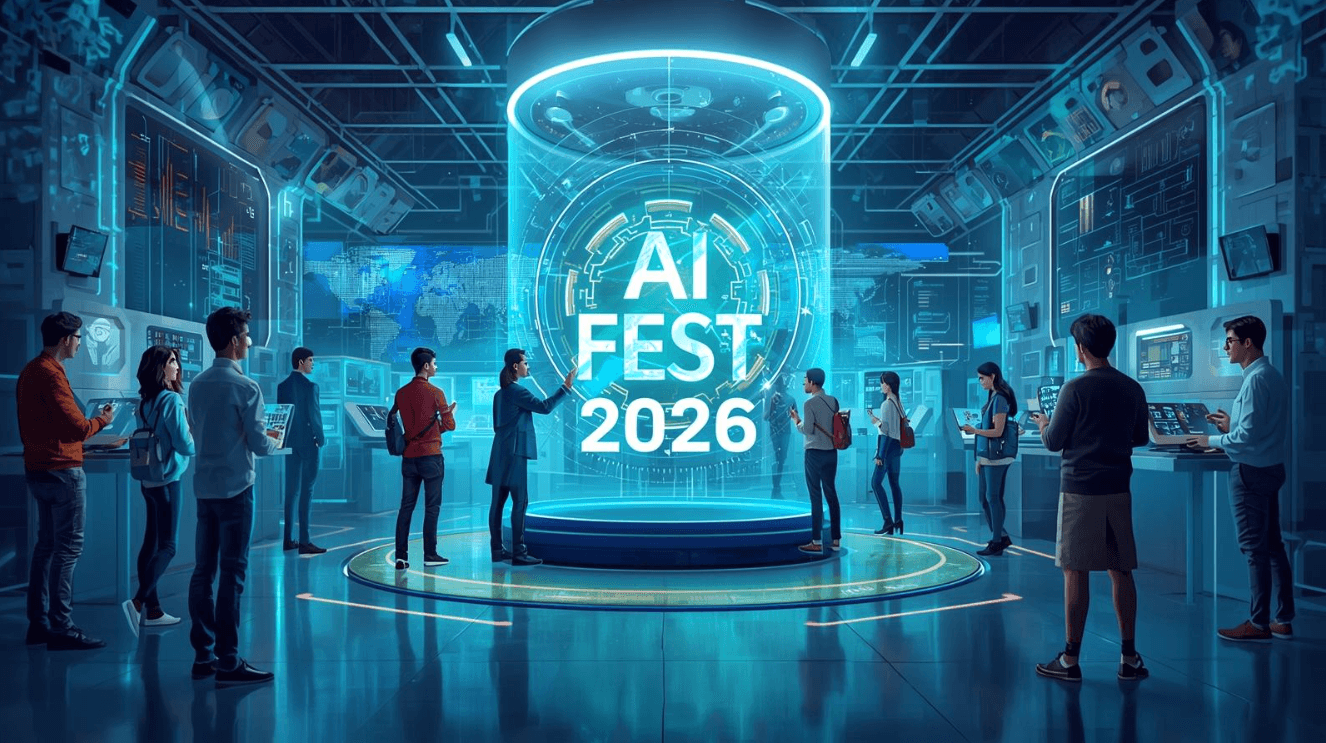
There’s a room at Chandigarh University where startups go to either die quickly or become unkillable. Only one rule: no faking it anymore.
Something strange is happening in Indian AI circles right now.
Founders with decent traction, real users, and GitHub commits that tell stories they’re quietly declining accelerator offers. Turning down demo days. Going dark on LinkedIn.
Where are they going?
SANDBOX.
It’s not a workspace. Not a program you can Google and apply to like Y Combinator. It’s what happens when you take every broken promise of the Indian startup ecosystem the “we’ll support you” lies, the mentorship theater, the pitch-and-pray model—and burn it down to build something that actually works.
And it’s all happening inside AI FEST 2026 this February at Chandigarh University, an event that’s less “festival” and more pressure chamber for India’s AI ambitions.
If that sounds dramatic, good. Because what’s about to unfold across three days in Punjab will either validate a radically new model for building AI companies in India or prove that we’re still not serious about moving from talent factory to company builder.
The stakes? Only India’s entire AI future. No pressure.
The Execution Desert (And Why Smart Founders Keep Dying There)
Here’s the pattern that keeps repeating:
Month 0: Brilliant AI engineer or student builds something clever. Real technology. Actual users.
Month 2: Wins hackathon. Gets media coverage. Investors circle.
Month 5: Hits the valley of death not capital, but focus. Twenty mentors with conflicting advice. Forty networking events. Zero revenue.
Month 8: Pivots. Then pivots again.
Month 12: Becomes consultant. “Doing some advisory work while exploring opportunities.”
Month 18: LinkedIn update: “Excited to announce I’ve joined [Big Tech Company] as Senior ML Engineer.”
Another one gone.
The Indian AI ecosystem has become a founder crematorium. We’re exceptional at celebrating sparks. Terrible at building furnaces that turn sparks into sustained fire.
It’s not a capital problem anymore. It’s an operating system problem. The infrastructure between idea and scale doesn’t exist not in a form that works for how AI founders actually build.
Traditional accelerators want you to fit their timeline. Move fast. Pitch often. Network constantly. But AI products don’t work like consumer apps. You can’t growth-hack your way to product-market fit in machine learning. You need depth, iteration, and most critically: uninterrupted execution time.
This is the void SANDBOX was designed to fill.
SANDBOX: The Intensity Engine Nobody Asked For (But Everyone Needed)
Forget everything you think you know about startup support programs.
SANDBOX doesn’t have an application portal. It doesn’t promise connections to investors. It won’t help you with your pitch deck. It doesn’t care about your LinkedIn follower count or how many hackathons you’ve won.
What it offers instead is almost uncomfortable in its simplicity:
One day of brutal clarity. Ninety days of zero-distraction execution. One outcome: you either have product-market fit or you have certainty it’s not going to work.
Here’s the framework:
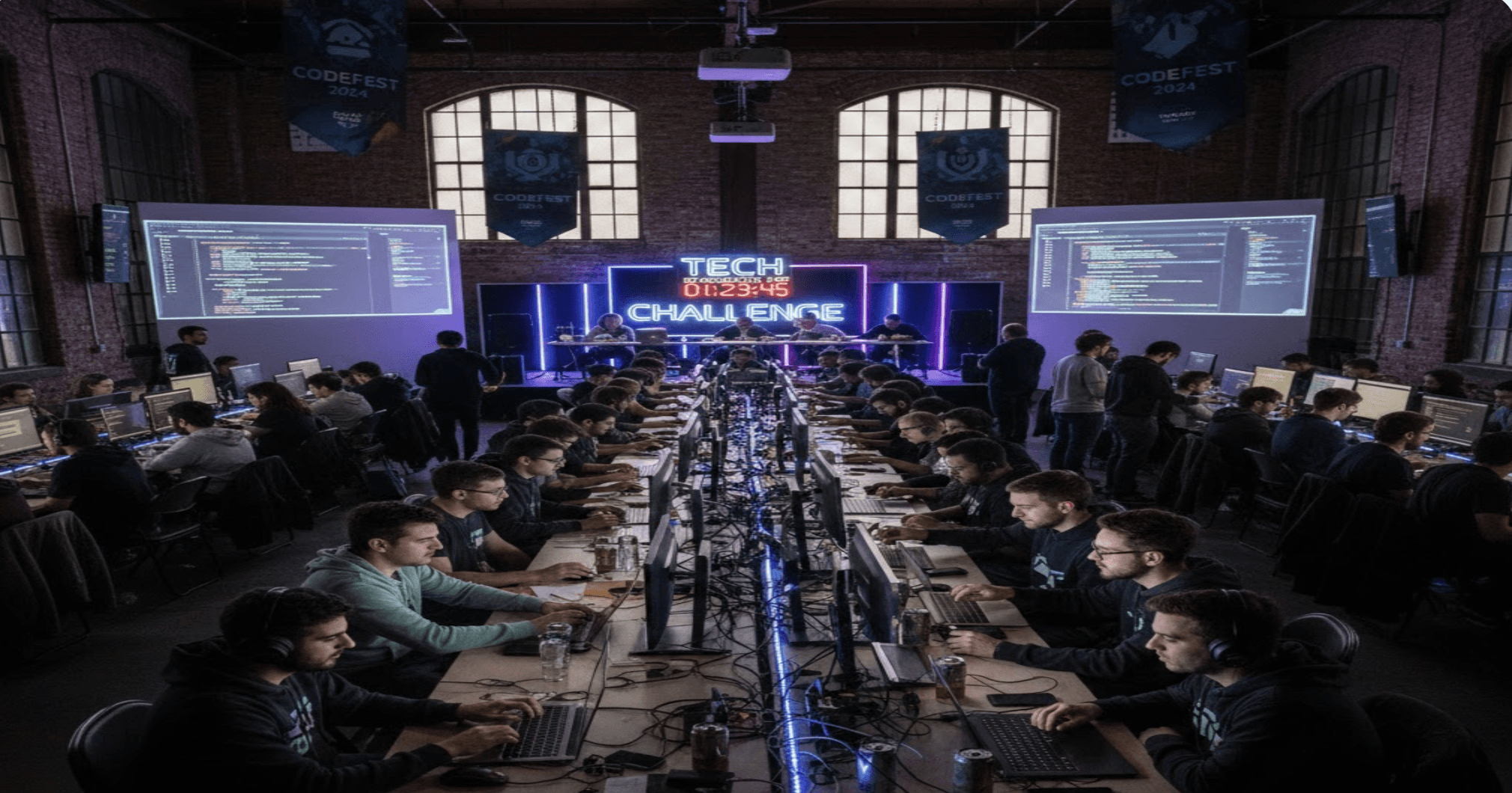
Day 1 happens during AI FEST 2026 in February. You enter an arena literally, a physical space Chandigarh University designed for intensity. No audience. No judges. No performance. Just you, your product, your users (or lack thereof), and a system designed to surface every assumption you’ve been avoiding.
Most founder programs start with “tell us about your vision.” SANDBOX starts with: “Show us your last 30 customer conversations. What did they actually say? Not what you heard what they said.”
It’s forensic. Uncomfortable. Necessary.
Because here’s SANDBOX’s core belief, the thing that makes it different from every other founder program in India:
“Most founders don’t fail because they lack intelligence or creativity. They fail because they lack intensity, focus, and support at the exact moment they need it most and nobody tells them the truth until it’s too late.”
Day 1 gives you the truth. Days 2-90 give you the infrastructure to act on it.
The 90-Day Residency isn’t remote. It’s not a Slack community where you post updates and get emoji reactions. It’s a physical and psychological operating system for execution:
Dedicated work environment (because working from coffee shops is cosplay, not productivity)
Founder-to-founder accountability (not networking accountability, the kind where someone asks “why didn’t you ship this week” and you can’t bullshit your way out)
Access to technical infrastructure for AI development (compute, datasets, APIs the expensive stuff that drains runway)
Structured validation frameworks (so you’re not just building you’re testing assumptions weekly)
Zero tolerance for distraction (no demo days mid-program, no “let’s grab coffee” requests, no conferences)
And here’s the part that makes VCs uncomfortable: SANDBOX doesn’t take equity. It’s not optimizing for portfolio. It’s optimizing for outcomes. Companies that survive. Products people pay for. Founders who don’t burn out or give up.
This is what post-hackathon infrastructure looks like when you actually care about what happens after the trophy photo.
Campus Tank: The Investor Gauntlet Where Student Founders Learn Money Has Memory
Now flip the script. What about founders who aren’t ready for SANDBOX’s intensity yet? Students still in the messy early phase, figuring out if their AI project could be a company?
Enter Campus Tank.
If SANDBOX is the execution engine, Campus Tank is the validation crucible. And it’s built on a premise that makes most college administrators nervous:
“Student founders don’t need more encouragement. They need more rejection the useful kind, from people with money and pattern recognition.”
Campus Tank runs across three days during AI FEST 2026, culminating on February 21 with live pitches at Chandigarh University. But it’s not structured like traditional student competitions where everyone gets a participation certificate and vague feedback.
It’s modeled after how real venture capital works. Because it involves real venture capital.
Built as a collaboration between Apna (the job platform that understands emerging India), Venture Catalysts (investors who’ve backed 300+ startups), and Chandigarh University (the academic backbone), Campus Tank operates on a simple thesis:
If your idea can’t survive investor scrutiny now, it won’t survive market scrutiny later. Better to learn at 21 than at 31.
Here’s the arc:
Day 1: Student founders enter with AI projects, MVPs, early traction whatever stage they’re at. First filter: Does this solve a real problem, or is this a class project with delusions?
Harsh? Yes. Necessary? Absolutely.
Because Indian campuses are drowning in “AI startups” that are just Jupyter notebooks and hope. Campus Tank’s job is to separate signal from noise fast.
Day 2: Survivors get access to operators not motivational speakers, but people who’ve built AI companies, dealt with regulatory nightmares, lost co-founders, pivoted three times, and somehow made it work. The conversations aren’t inspirational. They’re surgical: “Your unit economics don’t work. Here’s why. Fix it or die.”
Day 3 (February 21): Finals. Live pitches. Real investors in the room not judges, investors. People who write checks, not feedback forms.
And here’s where Campus Tank diverges from every other student startup platform in India: The goal isn’t winning. The goal is getting funded.
If your startup is legit, you walk out with capital, mentorship that doesn’t evaporate after the event, and a network that compounds. If it’s not legit, you walk out with clarity which is more valuable than false hope.
This is the bridge India’s AI ecosystem has been missing: a system that treats campus innovation seriously without coddling it. That connects student talent to institutional capital without pretending the gap doesn’t exist.
Why Chandigarh? (And Why That Question Reveals Everything Wrong With Indian Innovation)
Let’s address the elephant: Why is India’s most ambitious AI festival happening in Chandigarh and not Bangalore, Mumbai, or Delhi?
If your first instinct is “that’s random,” you’re thinking like the problem, not the solution.
Bangalore’s startup ecosystem is intellectually bankrupt. There, I said it. Not because of lack of talent or capital—because of monoculture. Everyone reads the same blogs, attends the same events, pitches the same VCs, hires from the same talent pools, and builds derivative versions of the same ideas.
Innovation doesn’t scale in monocultures. It needs cognitive diversity, which requires geographic diversity.
Chandigarh University is emerging as an AI and deep-tech hub precisely because it’s outside the traditional startup circuit. It has academic horsepower, infrastructure that rivals top metros, and most importantly: founders who haven’t been socialized into the Bangalore playbook yet.
They’re building for different users. Solving different problems. Using AI for agriculture, vernacular language, tier-2 city commerce, infrastructure not just another B2B SaaS tool for marketing teams.
AI FEST 2026 happening in Punjab isn’t a bug. It’s a feature of a distributed innovation model that India desperately needs if we’re serious about Viksit Bharat not just being Bangalore Bharat.
And Chandigarh University isn’t just hosting an event. It’s building permanent infrastructure SANDBOX residencies, Campus Tank pipelines, research commercialization frameworks that persist long after AI FEST 2026 ends.
This is what ecosystem-building looks like when you’re optimizing for decades, not Instagram reach.
The Three-Day Collision: What Actually Happens When India’s AI Ecosystem Converges
Describing AI FEST 2026 as a “festival” undersells it. It’s more like a compressed AI city that exists for 72 hours.
Imagine this:
SANDBOX founders mid-residency, debugging models at 3 a.m., having breakthrough conversations with researchers
Campus Tank finalists rehearsing pitches, getting destroyed by mentors, rebuilding their decks, repeating
National AI competitions where students solve actual problems healthcare diagnostics, climate modeling, financial inclusion
24-hour hackathons that aren’t about slides but shipping functional AI products
Investor open houses where founders with traction meet VCs without the song-and-dance of formal intros
Research showcases where academic AI work meets commercial application
Policy roundtables on AI ethics, data sovereignty, governance frameworks, societal impact
Sector-deep panels on AI in agriculture, healthcare, infrastructure, education, finance
Live product launches, cohort announcements, partnership reveals
But the real magic isn’t scheduled. It’s in the collision zones hallways where a student founder accidentally pitches an investor, late-night chai sessions where research meets product, chance encounters that become co-founder relationships.
AI FEST 2026 is designed to maximize collisions. To create the density necessary for serendipity to compound.
The Uncomfortable Truth About India’s AI Future
Here’s what nobody wants to say out loud:
India might lose the AI race. Not because we lack talent we’re top-tier. But because we keep optimizing for optics over outcomes.
We celebrate AI research papers but don’t commercialize them.
We produce AI engineers who leave for US companies.
We host AI events that trend on Twitter but produce zero lasting infrastructure.
We fund AI startups that pivot into consulting.
SANDBOX and Campus Tank are uncomfortable because they reject performative innovation. They don’t care about LinkedIn thought leadership or demo day aesthetics. They care about one thing: Do you have a product people pay for, and can you scale it?
If yes, we build the infrastructure to help you win.
If no, we help you figure that out fast so you don’t waste years.
This is what Innovation for Viksit Bharat looks like when you strip away the PR. It’s not inspirational—it’s operational. It’s not a vision it’s a system.
And the system goes live this February.
The Arena Opens
So here’s the situation:
If you’re an AI founder stuck in the execution desert, tired of mentorship theater and pitch practice, ready for 90 days of actual building SANDBOX is your exit route.
If you’re a student builder with real traction, tired of being patronized by “student startup” programs that don’t take you seriously Campus Tank is your shot at real capital.
If you’re an investor, researcher, or policymaker trying to understand where India’s AI infrastructure is actually being built (not theorized, not tweeted about, but built)—AI FEST 2026 is where the construction site is.
Three days. Chandigarh University. February 2026.
No promises. No hype. Just the arena.
Either you build something unkillable, or you learn why it wasn’t going to work. Both outcomes are valuable. Both are better than the slow death of ambiguity.
The 90-day gamble starts now.
Are you in?