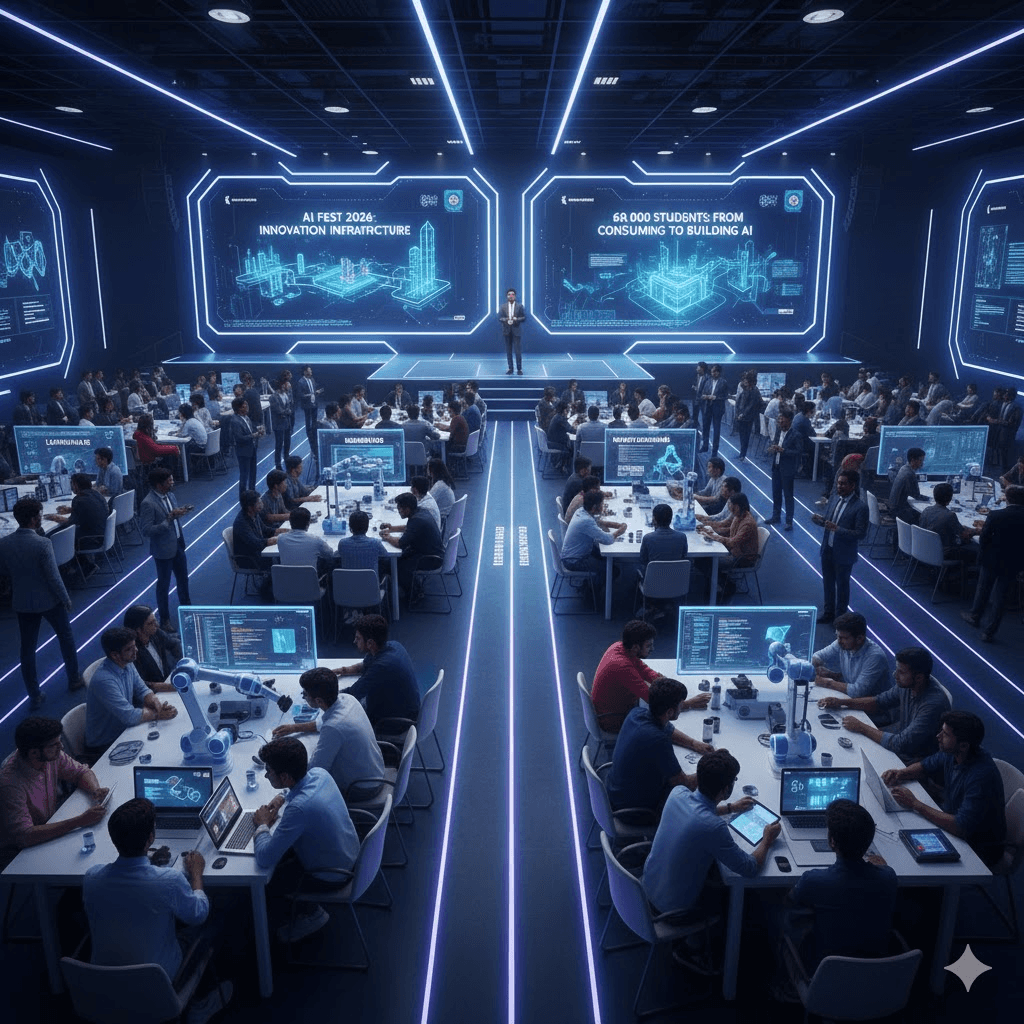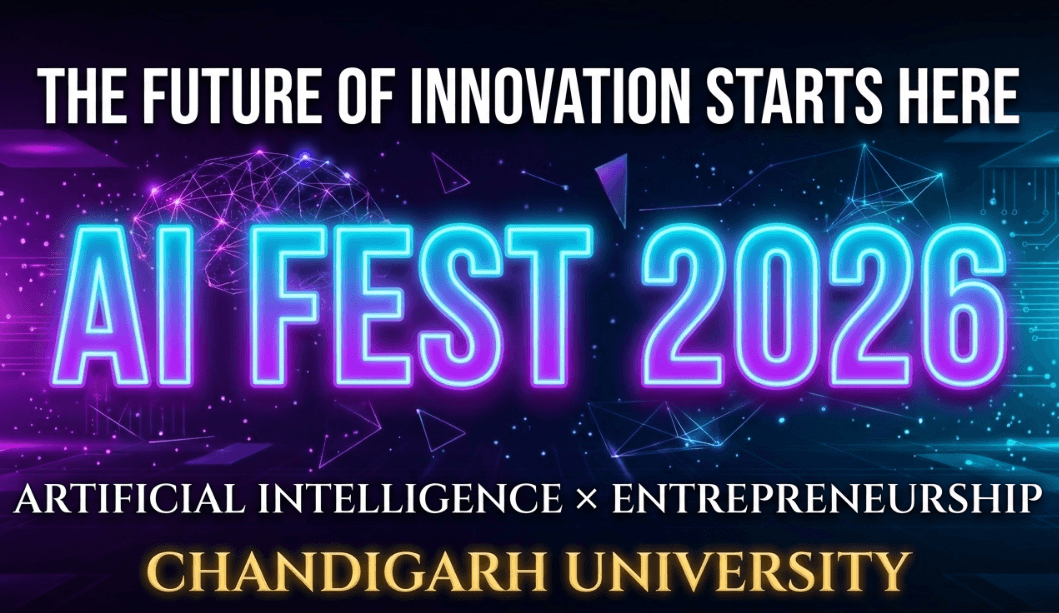
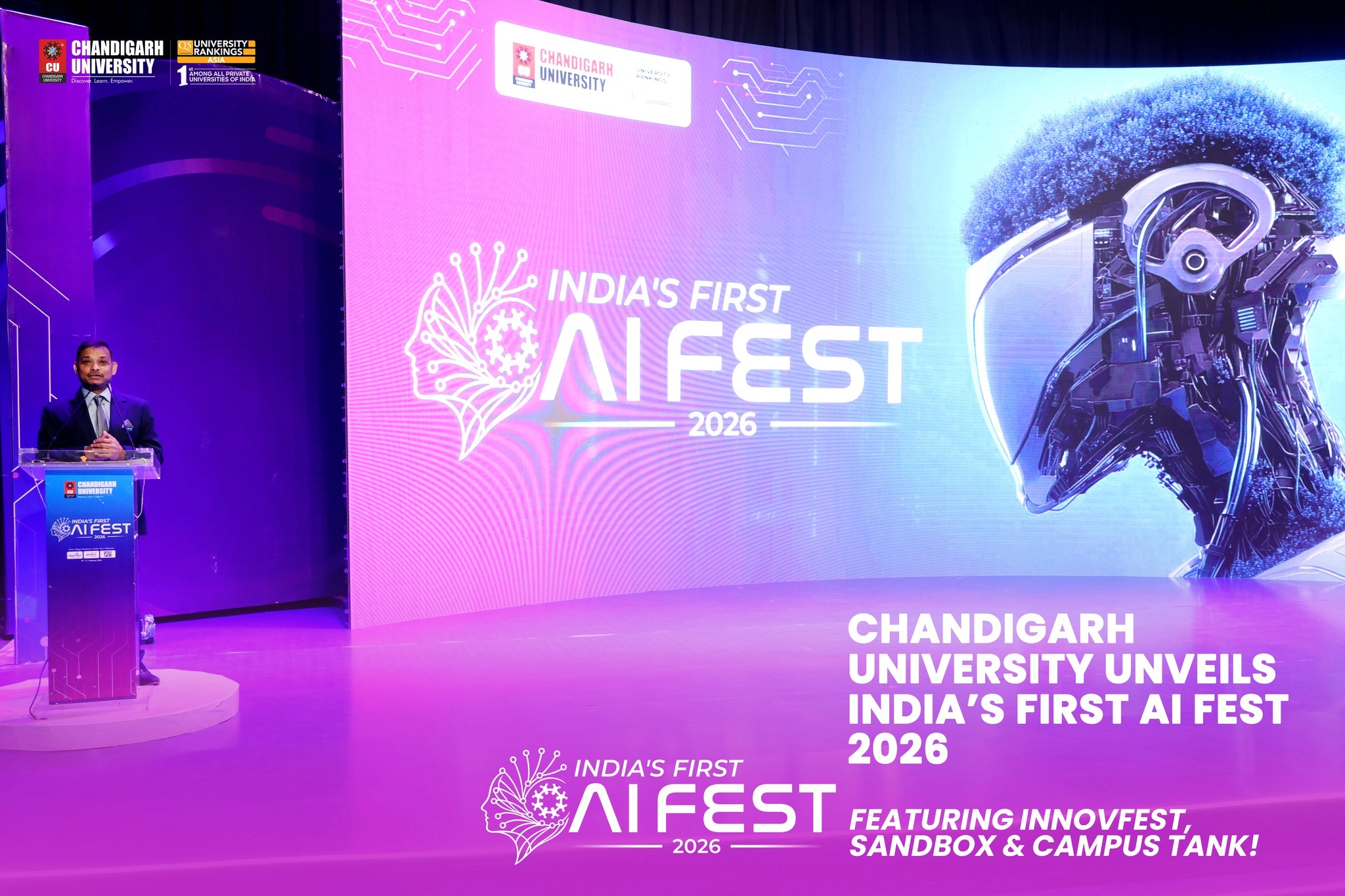
Picture this: A student in a shared hostel room, laptop balanced on their knees, debugging code at 2 AM. They're not preparing for an exam. They're building something—maybe an AI agent that translates government schemes into local dialects. Come February 19th, they'll be in Chandigarh with 60,000 others, not to watch the future unfold but to argue about what shape it should take.
This is the landscape AI Fest 2026 is stepping into.
When Building Becomes Believing
There's this moment happening across India's college campuses. A student—usually in their second or third year—realizes that AI tools aren't actually out of reach. They download an open-source model, follow tutorials, and suddenly they're making things that seemed like science fiction five years ago.
That realization is spreading beyond computer science departments.
AI Fest 2026 seems designed for this moment. Sixty thousand students. Four hundred startups. Forty investors. Twenty-five policymakers. All converging on Chandigarh University for three days. The numbers matter, but it's the composition that's revealing—this isn't just coders talking to coders. It's students who study medicine meeting students who study machine learning. It's entrepreneurs from tier-2 cities pitching to metro investors.
The Architecture of Possibility
They've structured these three days in a way that reveals how innovation actually happens.
Day One is InnovFest—pan-India competitions, panel discussions with industry folks and researchers. The ideation phase. Thirty-four events across disciplines, so a student interested in healthcare AI could jump between a biotech challenge and a smart cities discussion.
Day Two shifts to SANDBOX. The name isn't accidental—a sandbox is where you experiment without consequence. This is where ideas meet reality through founder-investor interactions, creator roundtables, mentorship. They're launching a Medical Cohort and a Media Cohort, suggesting sector-specific approaches rather than one-size-fits-all AI.
Day Three crescendos into Campus Tank's grand finale. Investors panels. Unicorn founders. Soonicorns. Demo days, startup exhibitions, product launches.
The progression: imagine, experiment, execute. It mirrors how actual products get built, which makes me think the real education isn't in keynote speeches—it's in watching the full cycle play out over seventy-two hours.
The $6 Million Question
There's a funding pool of $6 million attached to this event. That's not symbolic money. That's enough to meaningfully change the trajectory of a hundred early-stage startups.
But here's what interests me more than the dollar amount: the signal it sends. When real capital shows up to a university campus in Punjab, when investors are willing to sit through pitch after pitch from students who might not have the polish of Bangalore's startup ecosystem, something shifts in what young builders think is achievable.
I keep thinking about the students who'll pitch and won't get funded. (Statistically, that'll be most of them.) But they'll have made the pitch. They'll have gotten feedback from people who deploy capital for a living. They'll have watched which ideas got traction and which didn't. That's its own education.
And the ones who do get funded? They're not just getting money. They're getting validation that their instinct—to build something rather than wait for someone else to build it—was correct.
The Geographic Bet
Chandigarh is an interesting choice. Not Bangalore with its tech ecosystem. Not Delhi with its government proximity. Not Mumbai with its financial infrastructure.
Chandigarh sits at Punjab's edge, a state where agriculture dominates, where many students are first-generation college attendees, where median income looks different from metro centers.
By hosting AI Fest here, there's an implicit argument: Indian AI won't just emerge from established hubs. It'll come from places that understand different problems—rural healthcare, agricultural supply chains, vernacular language processing, financial inclusion in smaller markets.
When a Punjab engineering student builds an AI tool for crop yield prediction, they're not working from an abstract problem. They've seen it, maybe in their own family's experience. That proximity to real challenges might matter more than fancy infrastructure.
Four Conversations Happening Simultaneously
The event is organized around four themes, and reading through them feels like watching a debate with yourself about what AI should be.
"Evolving AI with Evolving Humans" starts optimistic—AI as augmentation, as evolution, as something that keeps humans at the center. It's the hopeful narrative.
Then immediately: "Ethics, Trust & Governance." Because hope alone doesn't build responsible systems. This track brings policymakers and legal experts into the same space as builders, which is messy and necessary. How do you regulate something that's changing faster than legislation can keep up with?
"AI-Engineered Reality" gets practical—healthcare, finance, infrastructure, smart cities. This is where abstract algorithms meet actual deployment challenges. Where you discover that building an AI model is 20% of the work and integrating it into existing systems is the other 80%.
And "Technical Frontiers" dives into the infrastructure: agents, platforms, open-source systems, no-code tools. The backend that makes everything else possible.
These themes don't resolve into a neat conclusion. They sit in productive tension with each other. Which feels honest. We don't have consensus yet on what AI should be, how it should be governed, or who gets to build it. So why pretend we do?
What Zero to One Actually Means
There's a program mentioned in the brief called "Zero to One" that apparently has already launched 40+ MVPs. Another one, "HackWithUttarPradesh," has produced 80+ MVPs.
Those numbers matter because they represent a pipeline. Not just one-off events where students build something and then it sits in a GitHub repository forever, but an ecosystem that's trying to move projects from conception to minimum viable product to actual deployment.
AI Fest 2026 seems to be part of this larger machinery—Campus Tank in its second season, SANDBOX being launched as "The Residency," cohorts forming around specific sectors. There's infrastructure being built here for sustained innovation, not just viral moments.
What February Might Quietly Mark
When I try to step back and see what AI Fest 2026 represents in the larger story of how India engages with artificial intelligence, I keep coming back to timing.
This is happening at a moment when AI has moved from research labs into everyday tools, but before we've figured out all the implications. When young people have access to powerful models but are still figuring out what to build with them. When there's capital available but it hasn't settled into predictable patterns of who gets funded and who doesn't.
It's a liminal moment. And maybe that's exactly when you need sixty thousand people in one place, arguing and building and pitching and questioning.
Because the decisions being made now—about what problems AI should solve, who gets to build it, how it should be governed, which innovations get funded—those decisions will shape the next decade. And they're not being made in boardrooms or policy documents. They're being made by people building prototypes at 2 AM, by students pivoting their final year projects toward real-world problems, by investors willing to bet on founders without pedigree.
February 2026 might be the moment we look back on as when India's AI story stopped being about catching up to the West and started being about building something distinct. Something that emerges from different problems, different contexts, different constraints.
Three days in Chandigarh. Sixty thousand people. Countless prototypes, pitches, and possibilities.
The future isn't arriving. It's being assembled, imperfectly and urgently, one conversation at a time.
Comments
Powered by Blogger
Theme images by Michael Elkan