
I’ve been tracking something subtle happening in India’s AI conversations over the past year or so. It’s not the usual LinkedIn hype about the next big model release or another think piece on “AI replacing jobs.” It’s more... structural.
People who build things are starting to talk to people who fund things. Students are showing up in founder circles. Researchers are entertaining questions from policymakers. Not in the sanitized panel discussion way we’re used to, but with actual intent behind it.
This didn’t happen overnight. We’ve had hackathons before—plenty of them. Smart India Hackathon has been running since 2017. HackWithIndia events pop up across campuses. There’s no shortage of 24-hour coding sprints or pitch competitions promising lakhs in funding. But most of these operate in silos. The engineering students show up to code. The business folks pitch. The investors skim. Everyone goes home.
What’s different now is the acknowledgment (finally) that these groups need to be in the same room, at the same time, actually listening to each other.
Which brings me to AI Fest 2026.
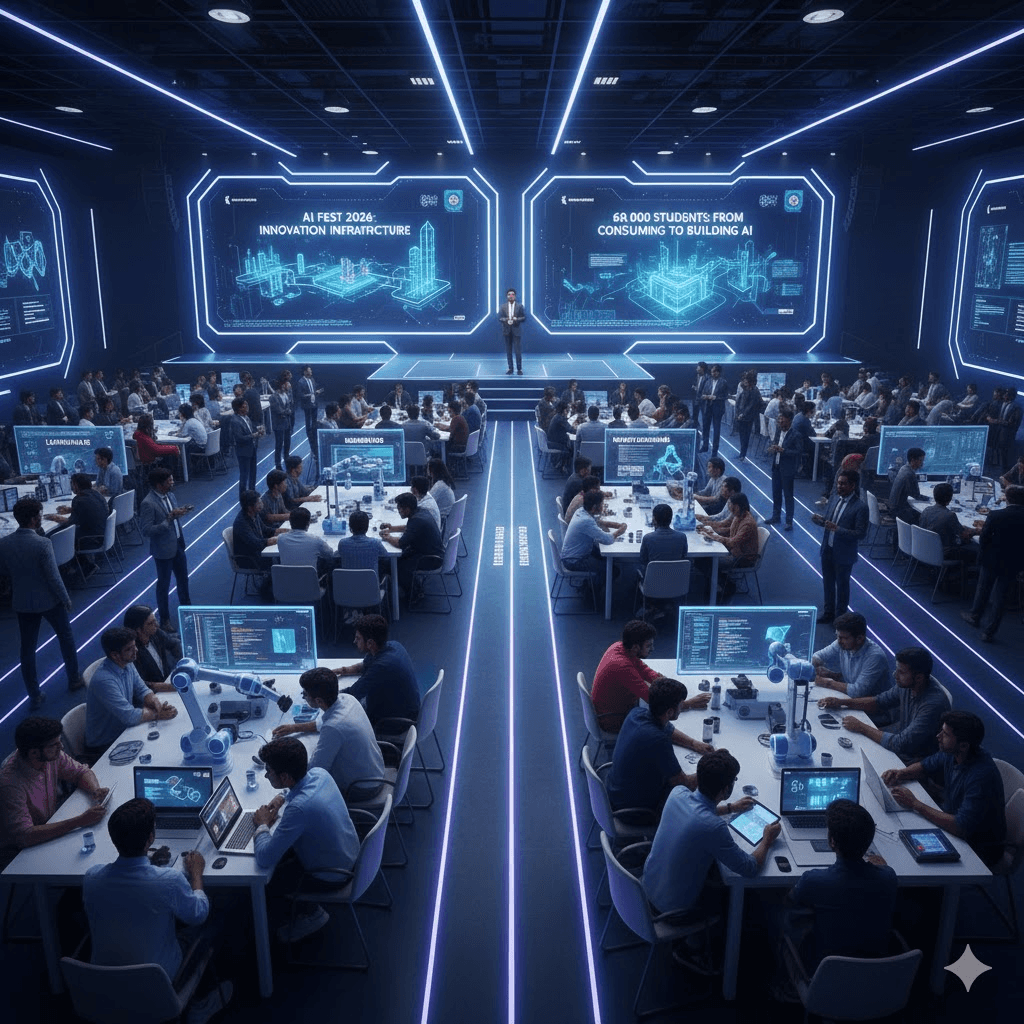
I’ll be honest—when I first heard about it, I thought it was another campus tech fest with an AI sticker slapped on. Three days in February at Chandigarh University. 60,000 students, they’re saying. Big numbers, decent lineup of events. Fine.
But then I looked closer at the structure, and something clicked.
Day 1 is InnovFest—essentially competitions across sectors with panel discussions. Standard fare, except the panels apparently include industry people, academics, researchers, and founders in the same session. Not separated by “track” or “audience type.” Just... everyone.
Day 2 is SANDBOX. The name caught my attention because it’s not trying to sound corporate or inspirational. A sandbox is where you experiment without breaking production. It’s where ideas can fail cheaply. The description mentions founder-investor interactions, creator roundtables, mentorship sessions, and something about launching medical and media cohorts. That’s a weird mix—in a good way. When was the last time you saw a creator economy conversation happening next to a medical AI cohort launch?
Day 3 is the Campus Tank finale and what looks like a flurry of launches, masterclasses, and demo days. Campus Tank, if you haven’t come across it, is this $6 million student founder fund that’s been quietly building over the past year. I’ve been watching it with interest because the structure is unusual—it’s not a traditional accelerator, and it’s not just throwing money at ideas. There’s a residency component, apparently.
The thing that makes this event feel different isn’t the scale. It’s the intent.
Most innovation events in India optimize for attendance numbers or “participation certificates.” This one seems to be optimizing for collision—literally putting 400+ startups, 40+ investors, 25+ policymakers, and 20+ creators in proximity and hoping something combusts. That’s either brilliant or chaotic. Probably both.
I keep coming back to the four core themes they’ve outlined: Evolving AI with Evolving Humans, Ethics and Governance, AI-Engineered Reality, and Technical Frontiers. These aren’t marketing categories. They’re actually attempts to frame where the conversation needs to go.
The first theme—AI augmenting rather than replacing humans—feels overdue. We’ve spent enough time in the “AI vs. humans” discourse. The second theme, Ethics and Governance, is where India genuinely needs movement. We don’t have clear regulatory frameworks yet, and having policymakers in the same venue as builders might actually accelerate something useful.
The third and fourth themes (real-world application and technical infrastructure) are where I think the students and startups will shine. Because that’s where the work is. Not in the abstract “what if” scenarios, but in the messy “how do we deploy this in Tier 2 cities” reality.
Here’s what I’m curious about: can you actually create meaningful connections at an event this size?
I’ve been to enough conferences to know that the best conversations happen in hallways, not in keynote sessions. The question is whether AI Fest has designed for those hallway moments or if it’ll just be a sequence of scheduled programming with everyone rushing between venues.
The SANDBOX residency concept suggests they’re thinking beyond the three days. That’s promising. We don’t need more one-off events. We need scaffolding—places where relationships can continue after the badges come off.
I’m also watching how the Zero to One cohort and HackWithUttarPradesh initiatives fold into this. 40+ MVPs launched through one, 80+ through another. Those aren’t trivial numbers. If AI Fest becomes a convergence point for these separate streams of work, that’s where it gets interesting.
Because here’s the thing: India has builders. We have students who can code, design, and deploy at a level that competes globally. What we’ve been missing is the connective tissue—the infrastructure that lets a student in Punjab talk to a healthcare investor in Bangalore, or a policy researcher in Delhi engage directly with someone building AI tools for government use cases.
That’s the promise here. Not just another event. A compression of ecosystems that usually don’t overlap.
I’m skeptical by nature. I’ve seen too many “inflection point” events that turned out to be inflection points for no one except the organizing committee. But the structure here is different enough that I’m paying attention.
So what will I be watching for in February?
First: the quality of founder-investor conversations in SANDBOX. Are investors actually engaging with MVPs that are pre-traction, or just scanning for the next obvious unicorn? Are students asking hard questions, or just pitching?
Second: whether the policymaker sessions produce anything beyond surface-level discussion. We need people shaping AI regulation to understand what’s actually being built, and vice versa.
Third: the cohort launches. Medical and media cohorts in AI feel like areas where India could leapfrog, but only if the execution is thoughtful. I want to see who’s behind these and what the follow-through plan looks like.
And fourth: honestly, just the vibe. Does it feel like an ecosystem starting to cohere, or just a large gathering of adjacent but still-separate communities?
If it’s the former, AI Fest 2026 might actually be the beginning of something.
If it’s the latter, we’ll have had a nice three days in Chandigarh and learned what not to do next time.
Either way, I’ll be there. Or at least, I’m planning to be.
Because if there’s even a 20% chance this becomes the place where India’s AI ecosystem starts to look like an actual ecosystem—not just isolated pockets of brilliance—that’s worth showing up for.
We’ll see in February.