There’s a moment in every founder’s journey when everything clicks or falls apart. It’s not dramatic. It’s quiet. You’re three months in, burned through your initial momentum, and suddenly realize: the hackathon trophy means nothing. The pitch deck slides don’t convert to customers. The ecosystem that celebrated your idea has moved on to the next batch.
Most innovation in India ends here. Not because founders aren’t smart enough, but because they’re abandoned at the exact moment intensity matters most.
AI FEST 2026 at Chandigarh University was designed for this moment.
Happening this February across three days, it’s not another technology festival trying to replicate Silicon Valley vibes with startup stickers and keynote applause. It’s something stranger and more necessary: an execution laboratory disguised as a national AI summit. A place where India’s artificial intelligence capability isn’t just discussed it’s stress-tested, funded, and built in real time.
This isn’t event architecture. It’s ecosystem engineering.
The Viksit Bharat Problem Nobody Talks About
India’s AI story has a weird contradiction. We produce world-class AI talent. Our engineers run machine learning teams at every major tech company globally. Our research papers get cited. Our startups get funded.
But somewhere between campus innovation and scaled companies, we lose people. The infrastructure gap isn’t about capital anymore it’s about operating systems for execution. It’s about what happens after the demo day, after the media coverage, after everyone stops clapping.
Innovation for Viksit Bharat can’t be built on hackathon tourism and LinkedIn storytelling. It needs environments that support the boring, brutal middle phase of company-building. The phase where focus matters more than networking. Where discipline beats creativity. Where founders need infrastructure, not inspiration.
That’s the design philosophy embedded into AI FEST 2026. Every panel, every competition, every program inside it asks one question: Does this help someone build something real, or does it just help us feel good about innovation?
And the answer shows up most clearly in two initiatives that anchor the entire festival: SANDBOX and Campus Tank.
SANDBOX: When Hackathons Grow Up
Let’s start with what SANDBOX isn’t.
It’s not a 24-hour hackathon where you build a prototype, pitch to judges, and hope for a prize. It’s not an incubator where you attend workshops and get introduced to mentors. It’s not an accelerator that takes equity in exchange for capital and connections.
SANDBOX is what happens when you strip away everything performative about startup support and ask: What do founders actually need when they’re two months away from either breakthrough or burnout?
The answer: One day. One arena. 90 days of transformation.
Here’s how it works. Founders enter SANDBOX during AI FEST 2026. One intensive day inside a structured environment problem validation, product stress-testing, execution frameworks. No bullshit. No theater. Just work.
Then the real program begins. Ninety days of focused execution. A residency model where founders aren’t left to “figure it out.” They’re inside a system designed to eliminate distraction and maximize velocity. Product-market fit isn’t a buzzword. It’s the operating metric.
The philosophy is surgical: Most founders don’t fail because they lack intelligence or creativity. They fail because they lack intensity, focus, and support at the exact moment they need it most.
SANDBOX provides that missing infrastructure. It’s built for the 3 a.m. decision-making, the should-we-pivot moments, the we’re-out-of-runway conversations that don’t fit into neat accelerator timelines. It’s a recognition that AI founders in India need depth, not breadth. Execution environments, not networking events.
This is a new operating model for AI startups in India. One that doesn’t optimize for demo day aesthetics but for companies that survive year two. For products that people pay for, not just applaud.
And it’s happening at scale. SANDBOX isn’t a pilot program for ten founders. It’s designed as national AI startup infrastructure replicable, scalable, serious.
If India wants to move from AI talent exporter to AI company builder, this is what the scaffolding looks like.
Campus Tank: When Student Innovation Meets Real Money
Now let’s talk about the other side of the ecosystem: students.
Campus innovation in India has a credibility problem. We’ve normalized a culture where “student startups” means unvalidated ideas, borrowed pitch decks, and competitions that end with certificates instead of cap tables. We celebrate participation, not outcomes.
Campus Tank is the corrective.
Built at the intersection of Apna, Venture Catalysts, and Chandigarh University, it’s a three-day startup launchpad that treats student founders like actual founders not kids playing business school simulation games.
Here’s the structure: Three days. One AI journey.
Student founders move from idea or MVP stage to investor-ready ventures. Not through workshops and motivational talks, but through structured validation, mentorship from operators who’ve built and scaled companies, and direct exposure to venture capitalists who write checks.
The culmination: February 21, 2026. AI FEST’s closing day. Finalists pitch live at Chandigarh University in front of investors from India’s venture ecosystem.
No participation trophies. No “everyone’s a winner” energy. Just founders, their startups, and capital on the table.
This matters because India’s AI future isn’t just about established companies. It’s about early bets on young builders who haven’t been institutionalized into corporate thinking yet. Students who see AI not as a resume item but as infrastructure for solving real problems healthcare access, financial inclusion, agricultural productivity, climate adaptation.
Campus Tank is a bet that campus innovation can be serious if we treat it seriously. If we stop condescending to students and start funding them. If we stop organizing innovation like extracurricular theater and start building pipelines that connect talent to capital to scale.
And it’s working. The student founders entering Campus Tank this February aren’t vague. They have traction, users, revenue models. They’re building in health-tech, fintech, agri-AI, infrastructure monitoring, vernacular language models. They’re not waiting for permission.
Campus Tank just gives them rocket fuel.
Why Chandigarh University? Why Now?
There’s a geography question embedded in AI FEST 2026 that’s worth addressing: Why Chandigarh? Why not Bangalore, Delhi, Mumbai the usual suspects?
The answer reveals something about how innovation ecosystems actually form.
Bangalore is saturated. Every founder looks the same, sounds the same, pitches the same. The infrastructure is world-class, but the cognitive diversity has flattened. Everyone’s chasing the same VC firms, hiring from the same talent pools, building variants of the same products.
Innovation doesn’t just need infrastructure. It needs weirdness. It needs people who aren’t socialized into the dominant narratives yet. It needs cities and universities that haven’t been completely financialized.
Chandigarh University is emerging as an AI and innovation hub not despite being outside the traditional startup metros, but because of it. It has academic infrastructure, student energy, and leadership that understands technology isn’t just taught it’s built. The campus has become a testing ground for national-level innovation programs, startup residencies, and research commercialization.
AI FEST 2026 is both a product of this environment and a catalyst for it. By hosting India’s largest artificial intelligence festival here, it’s making a statement: Innovation infrastructure isn’t just built in Bangalore anymore. It’s distributed. It’s networked. And it’s happening in Punjab.
This is critical for Viksit Bharat. If India’s AI capability is concentrated in three cities, we’ve just built another exclusionary system. If it’s distributed across tier-2 cities, university campuses, regional ecosystems—then we’re actually building national capacity.
AI FEST 2026 is a prototype for that distributed model.
What Actually Happens Across Three Days
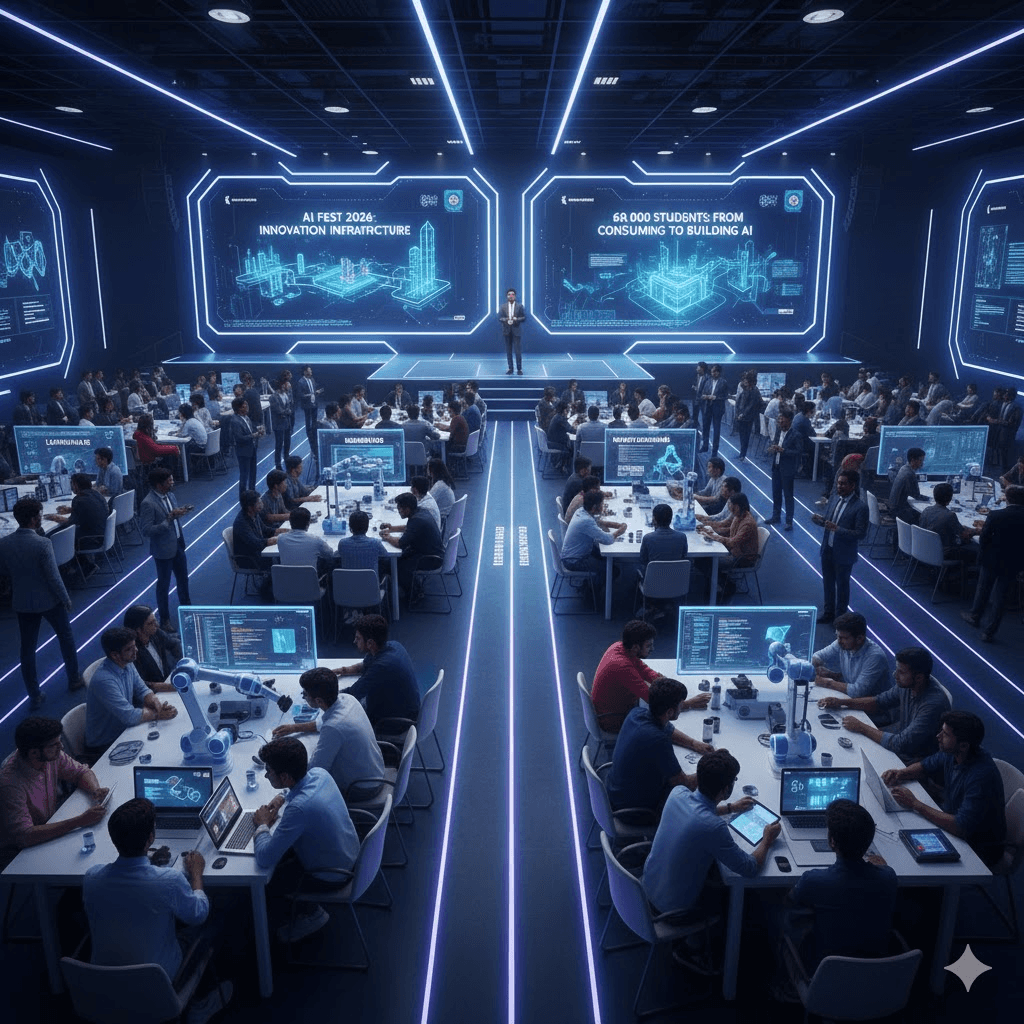
The festival itself is dense. Across February 2026, Chandigarh University transforms into a three-day AI city a convergence of founders, investors, students, researchers, policymakers, and builders.
You’ll find:
National AI competitions where students solve real problems, not hypothetical case studies
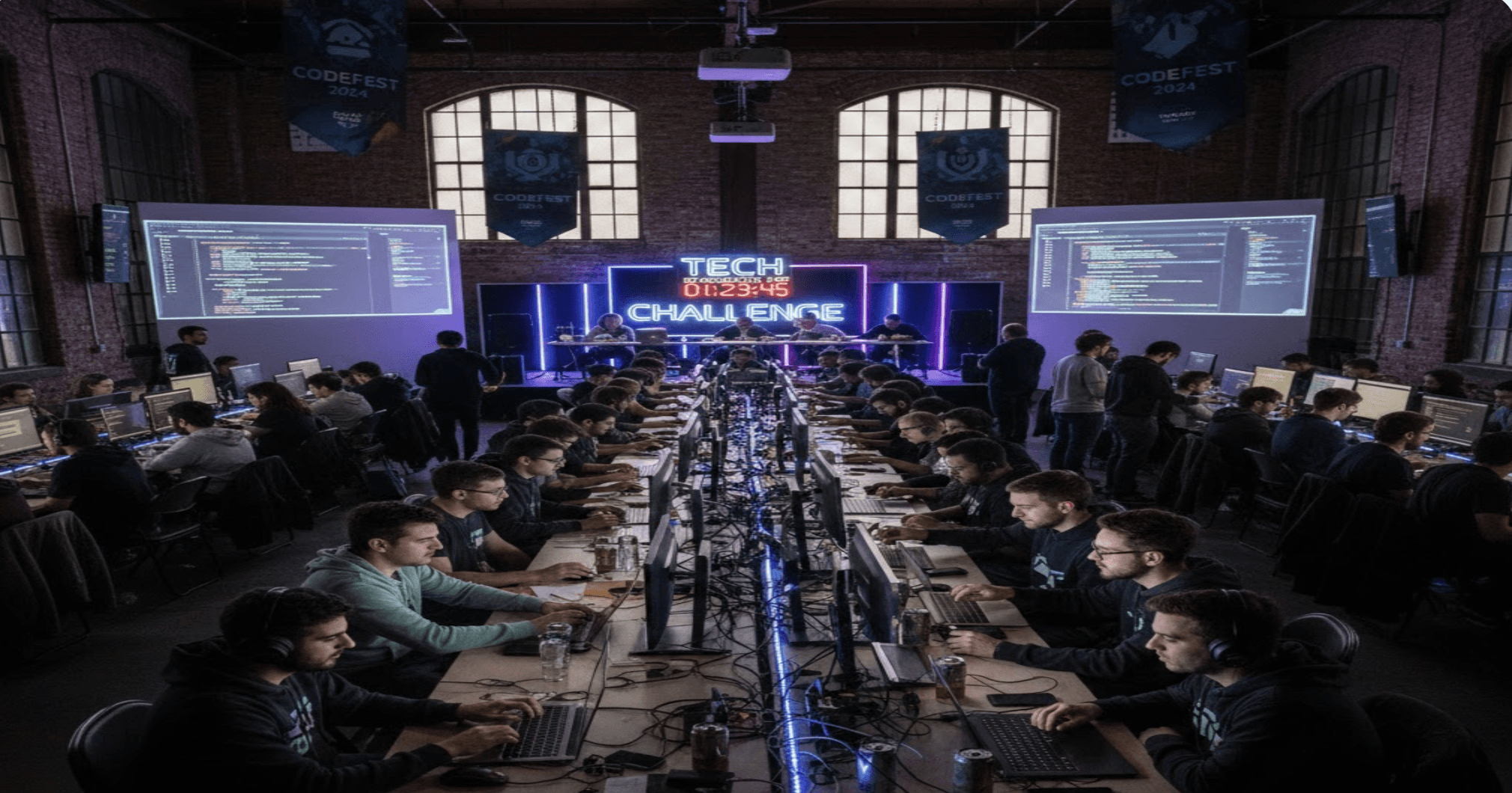
24-hour hackathons focused on product, not presentation
Startup showcases where young companies meet investors in open-house formats
Fireside chats with founders who’ve built and scaled AI companies—not motivational speakers, but operators
Research and policy panels on AI ethics, governance, data sovereignty, and societal impact
Sector-specific discussions on AI in healthcare, finance, agriculture, infrastructure, and smart cities
Live product launches and cohort announcements from accelerators and funds
But it’s not structured like a conference with rigid schedules. It’s designed as an open ecosystem—rooms where conversations spill over, founder-investor collisions that weren’t scheduled, late-night debugging sessions, spontaneous collaborations.
The chaos is intentional. Because innovation doesn’t happen in auditoriums. It happens in hallways, group chats, and 2 a.m. conversations where someone says, “Wait, what if we tried this instead?”
AI FEST 2026 is built to maximize those moments.
The Future of AI in India Isn’t a Prediction It’s a Construction Site
Here’s the thing about the future: it’s not inevitable. It’s not something that happens to us. It’s something we build, one decision, one founder, one product at a time.
India’s AI future won’t be decided in policy documents or keynote speeches. It’ll be decided in environments like SANDBOX, where founders get the support they need when it matters most. In platforms like Campus Tank, where student builders get funded instead of patronized. In ecosystems like AI FEST 2026, where execution isn’t optional it’s the default.
This February, Chandigarh becomes the arena. Not for performance. For construction.
If you’re an AI founder tired of noise, SANDBOX is your system.
If you’re a student builder ready for real capital, Campus Tank is your stage.
If you’re an investor, researcher, policymaker, or ecosystem builder trying to understand where India’s AI capability is actually being built not theorized, but built then AI FEST 2026 is where you need to be.
Not for the Instagram stories. For the outcomes.
Because innovation for Viksit Bharat isn’t a slogan. It’s infrastructure. And infrastructure gets built by people who show up, do the work, and refuse to settle for performative gestures.
The arena is open. The work begins in February.
See you in Chandigarh.