
Four Thematic Pillars That Reframe AI Discourse
What distinguishes AI FEST 2026 from other AI conferences is its thematic architecture. Instead of organizing around technologies (LLMs, computer vision, robotics), the festival structures conversations around four interconnected narratives:
1. Evolving AI with Evolving Humans
This theme challenges the displacement narrative. Rather than asking "will AI replace humans?" it reframes the question: how does AI become a catalyst for human evolution? Sessions explore AI's role in augmenting creativity, productivity, and decision-making - specifically examining the creators' economy, the future of work, and entrepreneurship. The "NARI: Women Leading Fronts" panel under this theme signals intentional diversity in AI development.
2. Ethics, Trust & Governance
As India develops its AI capabilities, the governance framework becomes critical. This track brings policymakers, legal experts, media leaders, and technologists into the same room to address data responsibility, regulation, and societal impact. The "AI & Data Sovereignty: Navigating Media, Law & Society" panel directly confronts questions around data localization, privacy, and India's position in global AI governance debates.
3. AI-Engineered Reality
Once ethical frameworks exist, AI moves from experimentation to deployment. This theme examines real-world applications across healthcare, finance, infrastructure, smart cities, design, and consumer experiences. Sessions like "Sentient Structure: AI in Infrastructure & Smart Cities" and "Future of Disruptive Healthcare" move beyond buzzwords to explore actual implementation challenges in Indian contexts.
4. Technical Frontiers
For builders, understanding AI's technical foundations is non-negotiable. This track demystifies how modern AI is engineered: agents, platforms, emerging technologies, open-source innovation, and no-code systems. The "Agents Council & No Code Platform" panel targets computer science and engineering students specifically, providing pathways for technical participation in AI development.
Why AI FEST 2026 Matters Now
The timing of AI FEST 2026 is significant. As global AI capabilities concentrate in the US and China, India faces a choice: become a consumer of AI technologies or participate in shaping them. AI FEST 2026 represents a third path - building AI capacity through distributed innovation across universities, startups, and industry.
Several factors make this approach particularly relevant in 2026:
Founder enablement infrastructure: Initiatives like Campus Tank ($6 million fund), ZERO TO ONE (40+ MVPs launched), and HackWithUttarPradesh (80+ MVPs launched) demonstrate systematic approach to converting student projects into fundable ventures. This isn't about one-off competitions - it's infrastructure building.
Cross-sector integration: By bringing together students from diverse disciplines (civil engineering, architecture, nutrition, physiotherapy, optometry, pharmacy, media studies, law), AI FEST 2026 acknowledges that AI's most significant impacts will emerge from domain expertise combined with technical capability.
Policy-industry-academia triangle: The presence of 25+ policymakers alongside 40+ investors and 60,000+ students creates conditions for meaningful policy feedback loops. India's AI regulations will be shaped by these conversations.
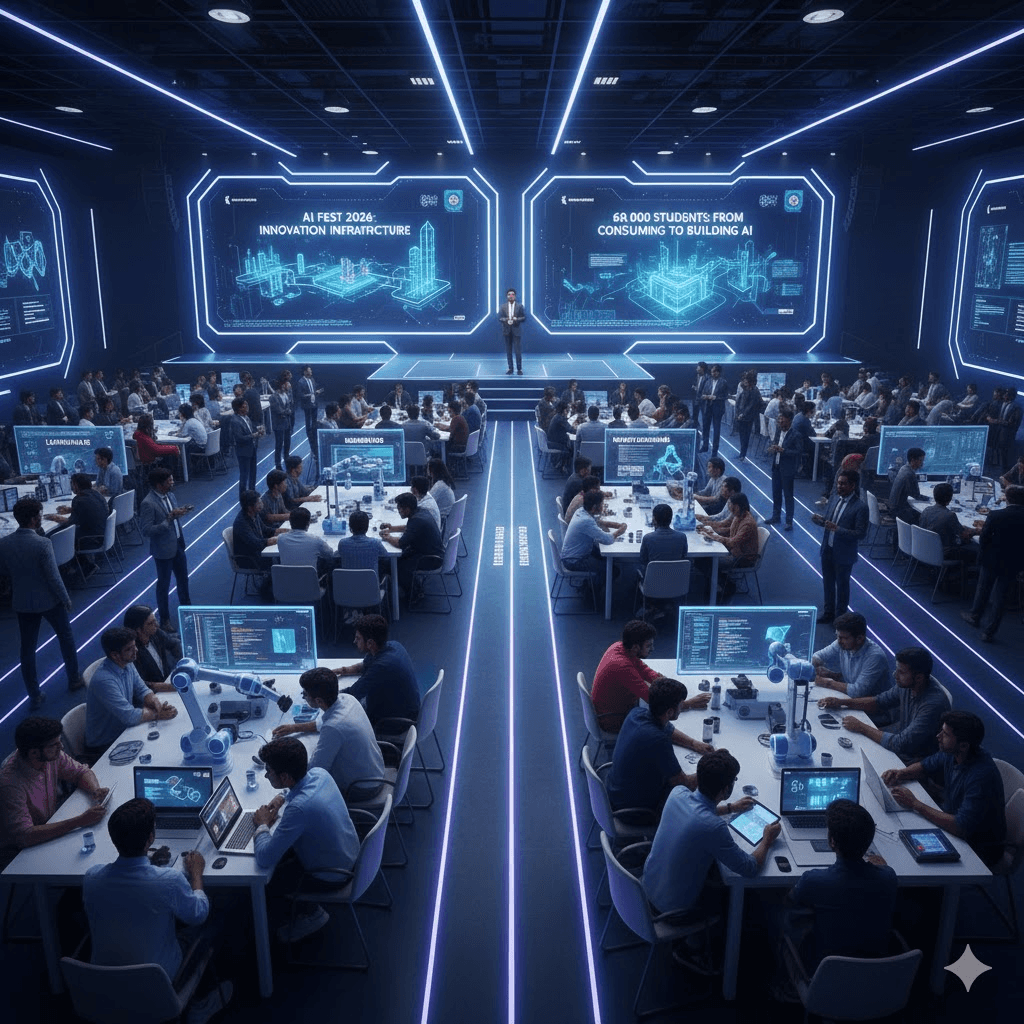
Democratized access to AI discourse: With 50+ events across multiple venues - from main stage panels accommodating 1,500 participants to focused seminars for 220 - AI FEST 2026 ensures students don't just hear about AI innovation; they participate in it.
The Startup Ecosystem Play
For India's startup ecosystem, AI FEST 2026 represents a significant validation moment. The festival's 400+ AI startup showcases provide market visibility, founder-investor interaction, and peer learning at scale. The structured pitch opportunities - from Pitching Battlefield to Campus Tank Demo Day - create multiple entry points for early-stage ventures.
The investor presence (40+ investors with $6 million in funding) signals genuine capital deployment interest, not performative participation. The separation of investor open houses, founder open houses, and structured panels suggests thoughtful curation rather than chaotic networking.
Content creators' involvement (20+ creators participating in roundtables) acknowledges that in 2026, startup success depends as much on distribution and community building as on product development. The "New Creators Economy & AI" panel explicitly addresses this convergence.
Who Should Pay Attention
For students and researchers: AI FEST 2026 offers direct access to industry practitioners, investors, and policymakers - relationships that typically take years to cultivate. The disciplinary diversity means computer science students aren't the only beneficiaries; healthcare, finance, design, and architecture students find relevant pathways.
For startup founders: The festival provides validation infrastructure (pitching opportunities), capital access ($6 million pool), and cohort programs (Medical Cohort, Media Cohort, BUILD initiatives) that convert MVPs into fundable ventures.
For investors: With 100+ MVP-staged startups pitching and 400+ startups showcasing, AI FEST 2026 offers concentrated deal flow across multiple sectors - healthcare, fintech, infrastructure, media, and consumer AI.
For policymakers: The festival creates direct feedback channels with students, founders, and industry leaders building AI applications. This isn't theoretical policy discussion; it's ground-level intelligence on what regulatory frameworks enable or constrain.
For corporates and industry leaders: The "Future of Work" and sector-specific panels (finance, healthcare, infrastructure) provide insights into how AI reshapes professional domains. The talent pipeline visibility - 60,000+ students engaged with AI applications - addresses workforce development concerns.
The Larger Signal
AI FEST 2026's significance extends beyond its immediate outcomes. It represents India's approach to AI development: not through top-down industrial policy alone, but through distributed innovation enabled by universities, backed by capital, and guided by policy frameworks developed in conversation with practitioners.
The festival's emphasis on builder culture (SANDBOX, Campus Tank, BUILD cohorts) over passive knowledge transfer; on sector-specific applications over generic AI capabilities; and on founder enablement infrastructure over one-time events suggests strategic thinking about India's AI trajectory.